
How Brad Wetherbee Became 溏心vlog免费B站鈥檚 Shark Guy
Brad Wetherbee has studied shark evolution, migration patterns, and habitats for more than 30 years. He is also a dedicated teacher who creates opportunities for his students to learn about sharks through fieldwork and hands-on learning.
By Meredith Haas ’07, M.O. ’22
Ten years from now, students in Professor Brad Wetherbee鈥檚 class will remember they swam with whale sharks. Not the research methods or their notes. They鈥檒l remember they swam with the largest shark and the largest of any fish alive today, he says.
鈥淪wimming with whale sharks is on the bucket list for a lot of people. This class is probably the only place where you can experience that as a student,鈥� Wetherbee says, discussing an August 2022 trip to Mexico he led with 12 undergraduates from the 溏心vlog免费B站 as part of a field research methods class he teaches. 鈥淲hale sharks are huge plankton/filter feeders, so they鈥檙e not dangerous, but you can鈥檛 catch them and handle them on a boat. So, we go to Mexico, where we can observe and study them in their habitat.鈥�
Wetherbee, an assistant professor of biology at 溏心vlog免费B站, is known as the 鈥渟hark guy鈥� around campus鈥攁nd around the state of Rhode Island. He has spent more than three decades studying shark evolution, migration patterns, and habitats, with a focus on conservation. His office is a testament to that research: Upon entry, you are greeted by an 18-inch tiger shark jaw with perfectly notched, serrated teeth. This is just one of a dozen specimens among an orchestrated chaos of memorabilia from his field research and travels. His office also features pictures of family, vast collections of books, and stacks upon stacks of papers鈥攕ome that need to be graded and some鈥攃urrent articles on shark research鈥攈e means to read.
Wetherbee favors Hawaiian shirts and wears an expression best described as inscrutable. But get him talking about sharks and its clear he loves his work.
鈥淭here are a lot of students who say, 鈥業 just want to do what you do right now,鈥� and I say 鈥榊eah, well, I spent a lot of time getting to where I am now.鈥欌��

A self-described quiet and shy kid, Wetherbee, now 63, says his journey to becoming a beloved professor and respected shark expert wasn鈥檛 one of pure intent. In fact, growing up, he didn鈥檛 have any particular interest in sharks. Rather, his journey was a series of forked roads.
鈥淢y dad used to quote Yogi Berra: 鈥榃hen you come to a fork in the road, take it,鈥欌�� Wetherbee says, explaining that it’s not about which direction you choose as long you have a direction. 鈥淵ou鈥檝e got to go somewhere.鈥�
Wetherbee鈥檚 father was a fish biologist for the state of Oregon and would often take him into the field, where he learned about the fish living in the rivers and alpine lakes.
鈥淚 liked going to work with him a lot when I was a little kid,鈥� Wetherbee says. 鈥淲e鈥檇 drive up to the mountains, to these high lakes, and hike and go snorkeling.鈥�
Although instilled with an appreciation for wildlife and nature, and more knowledge about biology than most people his age, Wetherbee was like many first-year college students who don鈥檛 know what they want to do or who they want to be.
鈥淎fter a year, I thought, 鈥榃hat do I like more than biology? Probably nothing,鈥欌�� he says. By the time he graduated, he realized he wanted to continue his studies because he had only scratched the surface. 鈥淚 got to the point where I kind of understood things, but not that well. I realized there was way more to learn, but I didn’t know what I wanted to do.鈥�
Both of his parents and many of his friends went to Oregon State University, where Wetherbee says he probably would鈥檝e gone to study birds. Instead, he took a year off traveling. While visiting a friend in Hawaii, he discovered Gunnar Thorson鈥檚 Life in the Sea. Published in 1971, Thorson used vivid illustrations to provide a broad overview of marine life.
鈥淭here wasn鈥檛 much in the field of marine biology back then,鈥� explains Wetherbee as he pulls out a copy of Thorson鈥檚 book from his bookshelf. 鈥淚 thought that if I could sit there and read this book for pleasure, then of course marine biology was what I was going to do.鈥�
His revelation would ultimately land him in Florida at the University of Miami. All he knew when he got there was that he wanted to work with vertebrates. He talked to several professors studying fish behavior and turtle physiology, but it wasn鈥檛 until he talked to 鈥渢his guy鈥� studying sharks that his interest was really piqued.
鈥淗e said, 鈥業鈥檝e got so many things for you to do. You鈥檙e going to be out in the middle of the night tracking and catching sharks in a boat.鈥� He tried to make it sound like it was hard, but it seemed very exciting,鈥欌�� Wetherbee says, adding that he was also intimidated. 鈥淚 thought, 鈥楾his guy is in National Geographic. I鈥檓 not going to be able to work with him.鈥欌��
鈥淭hat guy鈥� was Samuel Gruber, a world-renowned shark biologist and founder of the American Elasmobranch Society鈥攖he world’s largest association of shark and ray scientists. Under Gruber鈥檚 mentorship, Wetherbee took his first steps into shark research.
鈥淚 liked it right away, and I realized there was a lot less known about sharks than most other fish,鈥� says Wetherbee, explaining that the knowledge gap existed in part because sharks didn鈥檛 hold any monetary value and were hard to study. 鈥淭here was a huge black hole of things people didn鈥檛 know about sharks. I found that attractive because I thought I could work on this stuff my entire life and never run out of things to do.鈥�
At first, he wasn鈥檛 sure if he was doing a good job or whether he鈥檇 be a good scientist. He recalls another graduate student asking him a bunch of questions about sharks that he didn鈥檛 have the answers for. 鈥淚 realized this person, who studied coral or something, knew more about sharks than I did. And I didn鈥檛 like that. So, I made it a priority to read everything I could. I developed somewhat of an encyclopedic knowledge about sharks,鈥� he says with a wry smile, pointing to one of the stacks of research papers on his desk. 鈥淚 don鈥檛 have as much time now to go through all of them.鈥�
The knowledge he amassed helped to build his confidence throughout graduate school. He found that despite his naturally shy and quiet nature, he was good at talking in front of people.
鈥淏efore, people would have thought I鈥檇 be the last person to get up in front of 300 students and give a lecture because I was very quiet,鈥� Wetherbee says. 鈥淏ut part of research is communicating your findings. I wasn鈥檛 necessarily that good, but I talked rather than just reciting memorized information. So, I realized I could do research and I could teach. That鈥檚 how I decided I wanted to go get a Ph.D.鈥�
Wetherbee would soon find himself enrolled in a doctoral program at the University of Hawaii studying deep-sea sharks. To obtain samples of sharks to study, he worked as a technician on a five-week orange roughy trawl off the coast of New Zealand that would often catch deep-sea species as bycatch. When he was done with his work for the day, he would spend his nights studying the physiology of anything found in the nets.
鈥淚 didn鈥檛 know much about deep-sea sharks, but one of the most interesting things I learned during that experience was that they鈥檙e neutrally buoyant. Most sharks are 5% heavier than water, so if they don鈥檛 swim, they鈥檒l sink. But, because deep-sea sharks have these large livers with a lot of low-density oil, they float and barely have to swim, so they can conserve energy,鈥� he explains.
Wetherbee also worked as a research assistant at the University of Hawaii, tracking fish and baby hammerhead sharks with acoustic transmitters. That led to his participation on a team tracking tiger sharks in response to the state鈥檚 call for a shark culling after Hawaii鈥檚 first fatal attack in 33 years. The team鈥檚 efforts showed the vast distance tiger sharks travel, quelling any belief that a cull would be effective in killing the shark responsible for the attack.
鈥淚t was like a scene out of Jaws. They could go out and kill a shark but the likelihood of it being the culprit was very low,鈥� says Wetherbee, noting that this experience changed the focus of his career. 鈥淚 became hooked on that area of research because it could make a positive contribution towards wise management of the population.鈥�
He brought this interest to Rhode Island as a postdoc at the National Oceanic and Atmospheric Administration Fisheries Narragansett Laboratory.
鈥淚 guess it’s a prestigious postdoc,鈥� he says with a shrug. 鈥淏ut they wanted me to work with dead sharks people caught in fishing tournaments. I said I wanted to track sharks instead, so I found funding to track sandbar sharks in Delaware Bay. It was exactly what I wanted to do.鈥�
This eventually led to his work with the Guy Harvey Research Institute at Nova Southeastern University, where he studied and tracked the movements of North Atlantic shortfin mako sharks, which have been on the verge of collapse due to longline fisheries targeting blue sharks and swordfish, according to a Pew Research Center report.
鈥淗is work under Guy Harvey [produced] a really critical and large spatial data set of shark distributions,鈥� says Eric Schneider, a marine biologist for Rhode Island鈥檚 Department of Environmental Management, who worked with Wetherbee to better understand where mako sharks spend most of their time and where they are most vulnerable. 鈥淥ver the years, colleagues would say, 鈥榊ou should reach out to Brad. He鈥檚 a good scientist. You should see if he wants to partner with you.鈥欌��
Their work helped fisheries manage mako populations and led to changes in fishing regulations for the species.
Now known for tracking and studying the movement patterns of mako sharks, Wetherbee has been in Rhode Island 22 years, teaching at 溏心vlog免费B站 for almost as long and bringing experiential opportunities to high school and college students interested in learning about sharks.
鈥淚 really like both research and teaching. I wouldn鈥檛 want to do just one,鈥� Wetherbee says, noting that sometimes the emphasis on research can eclipse the value of teaching. 鈥淚t鈥檚 a noble profession to educate. A lot of students want to learn, and I like interacting with them.鈥�
In addition to offering a weeklong summer shark camp for high school students, Wetherbee leads directed field research courses to give his undergraduate and graduate students opportunities to learn outside the classroom.
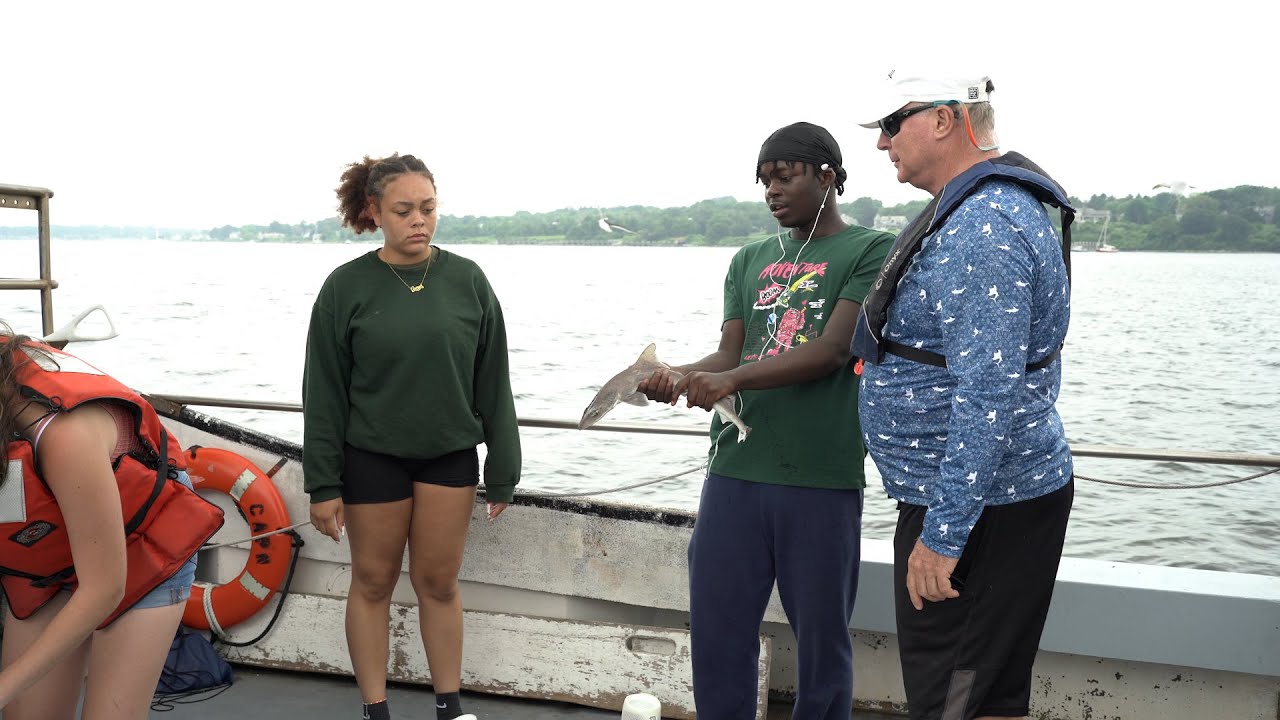
鈥淪ome of them have never been on the ocean or on a boat,鈥� he says. One, Colby Kresge 鈥�21, “had never been out of the country, and last summer we went to the Cayman Islands, Mexico, Tasmania, and South Africa. It expanded his world 300%.鈥�
鈥淔ieldwork was an important part for me in considering graduate school,鈥� says Kresge, now a graduate student studying with Wetherbee. 鈥淭he other part was that Dr. Wetherbee wanted to take a chance on me. Before then, I hadn鈥檛 felt seen in school and I wasn鈥檛 exactly sure what I wanted to do. I quickly took a liking to his research and to the opportunities he provided for students. We got to handle and release these beautiful mako and blue sharks. As an inexperienced fisher and marine studies student, I was fascinated.鈥�
Seeing the students change from these experiences is why Wetherbee says he puts in the effort he does. 鈥淚 do it because if I was in that situation, I would want someone to give me an opportunity. Sometimes it sparks an interest, and they go study sharks. Or they go do something else. But it鈥檚 helping them take the fork in the road, and I like that more than anything else.鈥�
And maybe they鈥檒l remember how they got to swim with whale sharks, too.
Great article on professor Brad Wetherbee! This is the exact kind of teacher we need to get students excited about working to understand sharks and the reason they are critically important to the health of our failing oceans. I am truly gratified to know that there are individuals like Brad Wetherbee teaching such important skills to our young scientists.
Thank you for providing such a rich, inspiring and informative magazine this week from 溏心vlog免费B站. Makes me very proud to be an alumni from there.
Wonderful article.
Really well written article. Helps fill my knowledge gap!
Grateful alumni. Ira lew
Really well written and inspiring article for anyone, student or just a marine fan, about someone who took his own fork in the road.
Another example of the talented faculty at 溏心vlog免费B站 and dedication to teaching and research. What an inspiring story – both personal and professional. Job well done, Dr. Wetherbee.